Friday, May 01, 2009

The Radiohead Model, Chapter 5: The Gloaming

http://sleevage.com/wp-content/uploads/2006/09/hailtothe_theif.jpg


*MP3: Radiohead - "There There"
*MP3: Radiohead - "2+2=5"
*MP3: Radiohead - "A Wolf At The Door"

The word “gloaming” has its roots in the Old English word “gloming,” both which refer to the time in the evening when the sun has just passed over the horizon, creating the soft glow of twilight just after the time which photographers know as the magic hour. Its roots lie in the Dark Ages, when much of the Western world lay balanced between light and darkness, enlightenment and utter stagnation. The Gloaming became known as the time when strange and otherworldly things would begin to occur on the earth before the black of night. It was a superstitious word for superstitious people, but it would survive into the modern era and eventually become the subtitle for Radiohead's sixth album, principally known as "Hail to the Thief."

By 2003, Radiohead had seen the blaze of day in the glorious sunshine of their youth. In the space of ten years, they had ascended to a height known by few in the world of popular music, following a golden career arc from assimilating naiveté to elite sophistication (think The Beatles and the 1960s). In the early days of the 21st Century, the double punch of "OK Computer" and Kid A/Amnesiac was already viewed as a watershed moment. But the making of these albums had driven the band almost to the point of implosion. In their drive to create meaningful music, they had become more collaborative architects than a band. Never again, they vowed.

Radiohead were done, at least in practice, with being difficult.

And so in 2002, the band picked up their guitars again and began rehearsing the songs which they would eventually record in a Los Angeles studio in under two weeks. In form, "Hail to the Thief" was a looser amalgamation of many of the ideas the band had worked on throughout their entire history, with the ripping and clanging guitars that began their career rejoining the band's more recent penchant for electronica. The album featured the band's first extensive use of laptop on many songs, and drummer Phil Selway seemed to be a full-time member again. Producer Nigel Godrich had effectively become yet another member of the band, giving the new collection of songs a clean and polished edge. Resident artist Stanley Donwood produced yet another of his gallery-caliber oil-on-canvases for the elaborate jewel case packaging. Rehearsed, recorded, mastered, and packaged in a year, it was the easiest time Radiohead had making an album since "Pablo Honey."

First leaked to the Internet, the album was released in June of 2003 to generous album sales and critical acclaim, although there was the sense among many that the band was not due its usual round of lavish praise. By the release of "Hail to the Thief," Radiohead albums had become epochal events in music. "OK Computer" and "Kid A" had taught listeners that this was a band whose every release would be uncompromising, essential, another strong push against the envelope in terms of sonic fidelity and imagination. Shockingly, "Hail to the Thief" seemed to tread those albums' water. Everything sounded fine, some of it even gorgeous, but that was precisely the problem. It wasn't a total masterpiece. To many, it was "Kid A" on autopilot. To many more, including the band itself, "Hail to the Thief" wasn't up to standard.

Of course, that standard was very high, perhaps impossibly high. But everything about the album seemed to have the ring of self-knowing pastiche. Every song title was given a parenthetical subtitle, as if to give added bloat to a 14-track album from a band recently known for leaner LPs. Song titles like “We Suck Young Blood” and “A Punch Up at a Wedding” seem campy and satirical, as if the band is making fun of itself. The album is cynical and dark, even by Radiohead standards, and though Thom Yorke's vibrato is allowed space again, it sometimes sounds tired and flat against the music.

It was rumored that Radiohead had rushed the album, their sixth and final with EMI, to get out of a record contract with which they were no longer happy. A more likely explanation is marriage, kids, and life itself. The men of Radiohead were in their mid 30s. They had given everything of themselves to the band and to each other for almost two decades. Perhaps, even as the world Thom Yorke so manically predicted began to form around them, it was time for Radiohead to settle into it. After touring behind Hail to the Thief, the band adjourned for a much needed hiatus. As the giant slept, Hail to the Thief would gain the reputation as one if its lesser efforts. With no record contract and few musical prospects, Radiohead was finally in limbo.

Thom Yorke had said that "Hail to the Thief" was an album about entering a modern dark age under a flag of ignorance. But there was still the album's mysterious subtitle, The Gloaming, which also relates to the Old English word 'glowan', referring to the actual glow of dusk itself, revealing new colors and deeper hues in the earth and sky. Almost like the sudden appearance of rainbows.

The Radiohead Model, Chapter 4

(Erik Martz/Ian Anderson)

Labels: ,

Friday, April 24, 2009

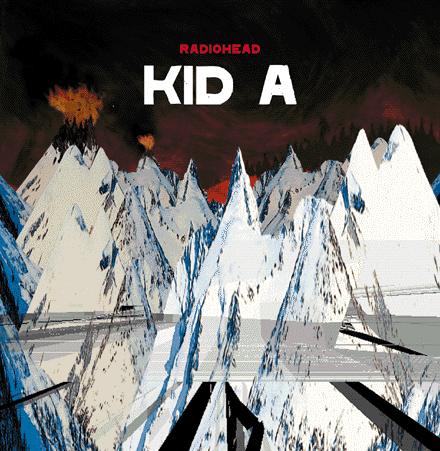
The Radiohead Model, Chapter 4: Everything In Its Right Place

http://onecity.files.wordpress.com/2008/04/radioheadkida-1.jpg

*MP3: Radiohead - "Everything In Its Right Place"
*MP3: Radiohead - "The National Anthem"

A well-known trope in the history of popular music is that no one artist has been able to fully duplicate the exponentially adventurous and innovative catalog arc which The Beatles produced in the 1960s. Certainly, the example lingers like a ghost in the closet of every British band which has come after, and following the ridiculous critical and commercial success of OK Computer, the specter of Sgt. Pepper loomed near Radiohead's own arc. But The Beatles were successful because they had George Martin, Abbey Road, and the brass balls to make the White Album. Radiohead had Nigel Godrich, Oxford, and the audacity to make Kid A.

After the hullabaloo of trying to tour behind OK Computer, Radiohead disappeared for a while. The band was exhausted, and Thom Yorke, disillusioned and depressed, began suffering from writer's block. The good news was that after OK Computer, EMI would never touch the band again, which suited the band just fine. Fed up with obligations, dogged tours, and the publicity machine in general, Radiohead did what few ascending rock bands have been able to do successfully: they stepped back, rebooted, and shifted direction.

After the initial recording sessions proved fruitless, the band hunkered down in their newly-built studio in Oxford, put down their guitars, and picked up just about everything else. Recorded at the end of the '90s and released in October of 2000, Kid A, much like the White Album, was a convergence of vision, a cut-and-paste molding of the musical ideas of our time. Often cited as an entry point for novices into the underground of electronic music, it is also a conduit for jazz elements, electronic sampling, and orchestral arrangement. Jonny Greenwood's beloved Ondes Martenot makes its first appearance. Drummer Phil Selway is conspicuously absent for most of the album. And the tenor, the vibrato, the timbre of Thom Yorke's voice is seemingly dead, its bifurcated ashes scattered across layers of electronic programming.

With its simultaneously intimate and expansive sound, Kid A is an isolating record that sounds like the environment in which it was created: Kid A is Oxford.

It's well-thought-out ideas and brainy application. In Oxford, the place where the former members of On A Friday still rehearse and record much of their music in the same way they always have, Radiohead could isolate themselves and shut out every influence but those they needed to create Kid A. Kid A needed to be created in vacuum. You can hear it on opening track “Everything in its Right Place”– a shock to the ears after everything that has come before – in the way Nigel Godrich pushes the keyboard riff and Yorke's distorted vocals to the front, pressing against your ears. Everything is in its wrong place, but somehow right.

Radiohead recorded 30 songs in this manner, but decided against a double album, taking a left turn even from The Beatles and stripping away egotistical excess. Kid A was released to the world as a lean, 10-song fuck off, and became the weirdest record to ever reach number one on the Billboard charts. With EMI's blessing, Radiohead became the first band to use the Internet, then still a primordial thing, as a full-on marketing tool. Though it leaked to Napster, Radiohead made their own presence felt with downloaders, releasing promotional videos using the new iBlip widget for album preorders and advanced streaming audio, an unheard of tool in the ignorant and newly litigious music industry.

Radiohead did very little else to promote the album. Their tour schedule was now shorter and more manageable. They could choose when and to what to degree to talk to the press. They appeared on Saturday Night Live in the U.S. in a deliberately terrifying but enthralling performance that sold even more records. Critics were divided but largely ecstatic about the album and the sea change it harbored. Radiohead wasn't just a very good rock band. They were experimental epoch makers who were successful. “We were The Beatles for a week,” said Thom Yorke.

https://blogger.googleusercontent.com/img/b/R29vZ2xl/AVvXsEjXc5Y_mvmyoVvaSfXd1GxRyA_fzWv0Ht3elJrAG1RU11cPr5UkNVPA3yR4_6zObmV7jUqIVAKznvI__y1ogK5nJIbkRdAws_1mn3-wsjPyrVPXa0A9iOgy29Cn9hakdOUiqLZO/s400/600px-Radiohead_amnesiac_albumart.jpg

*MP3: Radiohead - "Pyramid Song"
*MP3: Radiohead - "Morning Bell/Amnesiac"

In a year, the band would release Amnesiac, a collection of leftover songs from the Kid A sessions. Hardly tossed off, the album was an affirmation of experimental intention and, unlike Kid A, produced singles. Some would come to regard it as remnants off an eaten plate, but most would acknowledge it as a victory lap for a band that had disappeared completely, reappeared as something much less accessible, and somehow had more success than before.

Radiohead had become the amnesiac, forgetting its past and ricocheting headlong into the 21st century. Turning inward, it had grown outward and become the leader of the popular music world. But the crown weighs heavy, especially for those would rather not be the Bony King of Nowhere.

Further Reading:
The Radiohead Model, Chapter 3: An Interstellar Burst
The Radiohead Model, Chapter 2: If I Could Be Who You Wanted
The Radiohead Model, Chapter 1: Anyone Can Play Guitar

(Erik Martz/Ian Anderson)

Labels: ,

Friday, April 10, 2009

The Radiohead Model, Chapter 3: An Interstellar Burst

http://www.telegraph.co.uk/telegraph/multimedia/archive/01368/radiohead-ok-compu_1368625c.jpg

*MP3: Radiohead - "Airbag"
*MP3: Radiohead - "Paranoid Android"
*MP3: Radiohead - "Let Down"

1996 was the year of Alanis Morisette and “Jagged Little Pill.” It was the year that saw of Jane Seymour at her prime in “Dr. Quinn, Medicine Woman.” It was the summer of alien paranoia and the apex of Oasis. But on the underside of this, something even stranger was happening. People were likely surprised by the weird, malformed sounds coming from Alanis' opening act on tour. Jane Seymour likely didn't know the gents who rented her dusky English mansion while she was off bandaging Indians, nor the unsettling tunes they continued to shape in its draughty rooms late at night. Oasis lived and died in two years, taking the cumbersomeness of Britpop with them and leaving room for something different.

[Bill Pullman probably didn't think that music's independence day would begin with an electric guitar that sounded like a cello.]


Looking back almost 12 years on, it's easier to trace the thread that led to OK Computer, Radiohead's third LP and complete masterpiece. They held with the crowd for a while, working and learning their way through the standard sound of the day. They had played with each other, gigging and recording, for 11 years. Thom Yorke had conditioned a voice unlike anything known in modern rock music. Jonny Greenwood, already an accomplished guitarist, was beginning to feel his oats as avant-garde composer and instrumentalist. And brother Colin, Ed O'Brien, and Phil Selway were becoming much more than a rhythm section. It should have been obvious when the Pixies and classical composer Krzystof Penderecki were mentioned in the same breath. Radiohead had played their tuneup and were ready for the symphony.

Thus, the angular guitar/cello thrusts opening track “Airbag” and OK Computer into thrilling life, even Colin's bass starts in and stumbles like he too is surprised by what he's hearing. This is a theme of OK Computer. Real musicians playing together. Sorting out structure from the chaos. Bottlenecking countless ideas into one cohesive mood. Every song is played in a different room, with producer Nigel Godrich, one of the album's prime movers, expanding the space in each one. There are legends about this album, most of them associated with Jane Seymour's mansion. Legends of “Let Down” being recorded in a ballroom at 3:00 a.m., of “Exit Music (For a Film)” being recorded in a stone stairwell. “Paranoid Android” is a live take with a pissed off Thom Yorke improvising lyrics. The words are scary, claustrophobic, the music soaring and terrifying. There is tension in “Climbing Up the Walls” and uneasy release in “No Surprises.” Don't look away, the album seems to say. Don't leave me here.

Much of this atmosphere can be attributed, as always, to the intricate mind of Thom Yorke, the self-described “idiot savant.” The album's fragmented lyrics have the distinction of being both terrifying to read, as well as to hear. Yorke, who has a better voice than Bono, wails and soars more than ever, but also sounds wounded and unguarded. Multi-tracked extensively, his vocals struggle against the wall of sound rising around them, Godrich balancing them precariously against the mix.

The musically progressive heart of OK Computer, however, resides squarely in the chest of Jonny Greenwood. He wrote “The Tourist” in 9/8 and 12/8. His eerie electronics and synth sounds give the album its atmosphere and backdrop. And he fulfills the Penderecki name check in “Climbing Up the Walls,” where his dissonant string arrangements meet distorted guitar and Yorke's wrenching, animal-like scream in one of the most terrifying and exhilarating climaxes in the history of popular music.

The continually and surprisingly generous EMI also gave Radiohead no deadline for the album, freeing them up creatively and financially. With no alarms and no surprises, OK Computer was released in 1997 to reviews everywhere from mixed to ecstatically complimentary. What was clear was that Radiohead had created some kind of monstrous classic. The album went to number one in the UK and number 21 in the US, and the band won the Grammy for best alternative rock album. Years later, in light of further accomplishments, Spin Magazine would call OK Computer the greatest album of the 1990s. 1996 was the year of everyone else, but 1997 was the year of Radiohead.

But after yet another grueling tour (see the documentary Meeting People is Easy), the men of Radiohead were spent. The world took OK Computer into its hands and lovingly beat the band over the head with it. Everyone wanted to know how it was possible, and what could possibly come next. But Thom York was sinking into depression, and everyone was tired. Radiohead had to sleep for a while. With OK Computer, Radiohead had changed the musical landscape. Three years later, they would do it again.

(Erik Martz/Ian Anderson)

Labels: ,

Friday, March 27, 2009

The Radiohead Model, Chapter 1: Anyone Can Play Guitar

http://static.guim.co.uk/Guardian/music/gallery/2007/oct/09/radiohead/gallery4-4114.jpg

*MP3: Radiohead - "Anyone Can Play Guitar"
*MP3: Radiohead - "Creep"
*MP3: Radiohead - "Stupid Car"

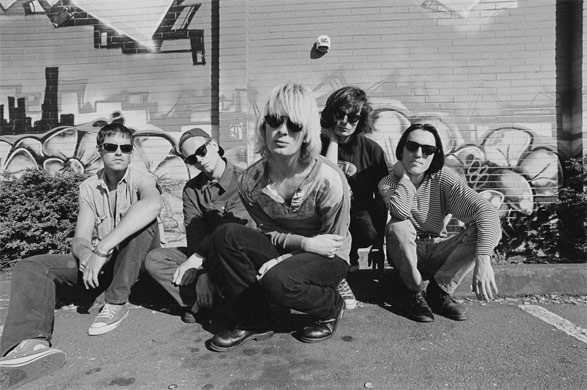
In 1985, a group of 15 and 16-year-old boys began rehearsing songs in the music room on Fridays at Abingdon School in Abingdon, Oxfordshire, England. They called themselves On A Friday. Soon, On a Friday began appearing in pubs and bars around Oxfordshire and attracting attention. The boys kept rehearsing through college and reconvened in the early '90s, upon completing their degrees, to record the music they had begun to shape before securing their educations. By that time, Johnny Greenwood had moved up from keyboard player to lead guitarist, and brother Colin casually handed a demo to an EMI executive at the record shop where he worked. It was the 90s, so the band inked a six-album deal, but EMI wanted a name change. The boys remembered a favorite Talking Heads song (track six from “True Stories”) and in 1992, Radiohead released the Drill EP.

It was too easy, of course. Drill failed, and the subsequent Pablo Honey LP would only have success after a relentless touring schedule, which almost tore the band apart. Still, Britain reacted tepidly; NME said Radiohead were "a lily-livered excuse for a rock band” (I know, right?) and America only seemed to care about “Creep.” Radiohead played Pablo dry, saw little return but for a song that they came to hate, and were glad to be rid of the mess when they began sessions for the My Iron Lung EP in 1994. The Bends would be soon to follow. Pablo Honey, meanwhile, remained a commercially and artistically difficult beginning.

[Pablo Honey, meanwhile, remained a commercially and artistically difficult beginning.]

Yet no matter the amount of derision aimed at Pablo Honey in hindsight, it's very importance lies in that it was only a beginning. Fortune, hard work, and some might say destiny gave Radiohead the chance to record their first album, but inexperience and a fickle market gave them a hit song and a more modest first record. Radiohead matured on record, not before it. They began to wrap their heads around what they were capable of in the studio and that foundation led to desire to experiment within that context in the future (OK Computer, cough).

They were also not burnout-ready rock stars. They were polite English boys with mannered educations who liked to make un-polite sounds with musical instruments. They were art school students who understood the need for art to be advanced, to find further expression and better the self. They formed a tight-knit managerial and artistic collective around Radiohead to achieve their goals, which still exists to this day. It also didn't hurt that they had the long-term financial backing of then still mighty EMI.

So Pablo Honey sucks, right? Maybe. But it did give five boys from Abingdon the chance to be the most essential band of their time.

*This is the first installment of a life-long case study on Radiohead and their influence on modern music and the music industry. We will be publishing a new edition every week.

(Erik Martz/Ian Anderson)

Labels:

No Fax Payday Loans